I’m seriously questioning what I was even thinking when I decided to take a pharmacy major taught in full Chinese.
I’ll be starting my pharmacy degree next year, and honestly, that thought fills me with anxiety. I didn’t know if I could survive next year. Then I found out something that changed everything: I could just sit in on college classes. So I jumped at the opportunity and started asking people from different majors if I could sit in their class, just once. Sometimes I’m surprised by what doors are open to me if I just ask.
If you’re new here — some quick context before we get into it: I passed HSK 4 and have learned nearly all the HSK 5 vocabulary. I’ve lived in China for almost a year now, attending pre-major language classes taught in Mandarin, so my listening ability is decent. Decent enough for daily life, anyway. University lectures? That’s a different beast entirely, and this whole experiment was me trying to find out exactly how different.
Most Chinese university classes take attendance via online forms, so usually teachers won’t notice if a random person sits in. I brought some notes and pretended to be writing down things the teacher was saying, just to blend in, hahahaa.
Here’s the general listening-difficulty disclaimer for basically every class below: since these are university-level classes, the teachers use a lot of technical vocabulary. I could only catch the words I already knew and get a rough idea of the topic, while the actual explanations flew right past me. They talk at a normal pace for a native speaker — which is basically 2x speed for a foreigner :’D.
Different majors turned out to have very different teaching styles and difficulty levels. Here’s everything I sat in on, in order, ranked by how much I actually understood.
Macroeconomics (Tourism Major) — 40% Understanding
This was the first class I tried sitting in on. I only did it because my friend offered to bring me along — and honestly, her offer is what made me realize random class-hopping was even possible in the first place.
The atmosphere was pretty formal, and the teacher was dressed smartly, while the students dressed casually like usual.
I could tell she was a genuinely great teacher. She’d pull up websites comparing GDPs of different countries, draw conclusions and analysis live, then switch back to her own PowerPoint. A really interesting way to connect concepts to the real world.
Not all the Chinese students were locked in, though — some were just playing games on their phones. Honestly? I was so jealous of their carefree attitude. They get to be carefree because it’s their native language. They never have to worry about not following the class, because of course they understand everything.
When listening to her, I could tell she was talking about macroeconomics — but I couldn’t follow the actual explanations.
Comprehensive Class (综合), Mandarin Language Major (汉语语言专业) — 95% Understanding
This is the only class where I actually asked the teacher beforehand if I could join (every other class, I just walked in and sat in an empty seat, hahahaa). I already knew her since she also teaches my Listening class, and she’d once told my class we were welcome to sit in, so I felt comfortable reaching out.
She’s always so well put-together — pretty dresses, makeup that’s polished without being over-the-top.
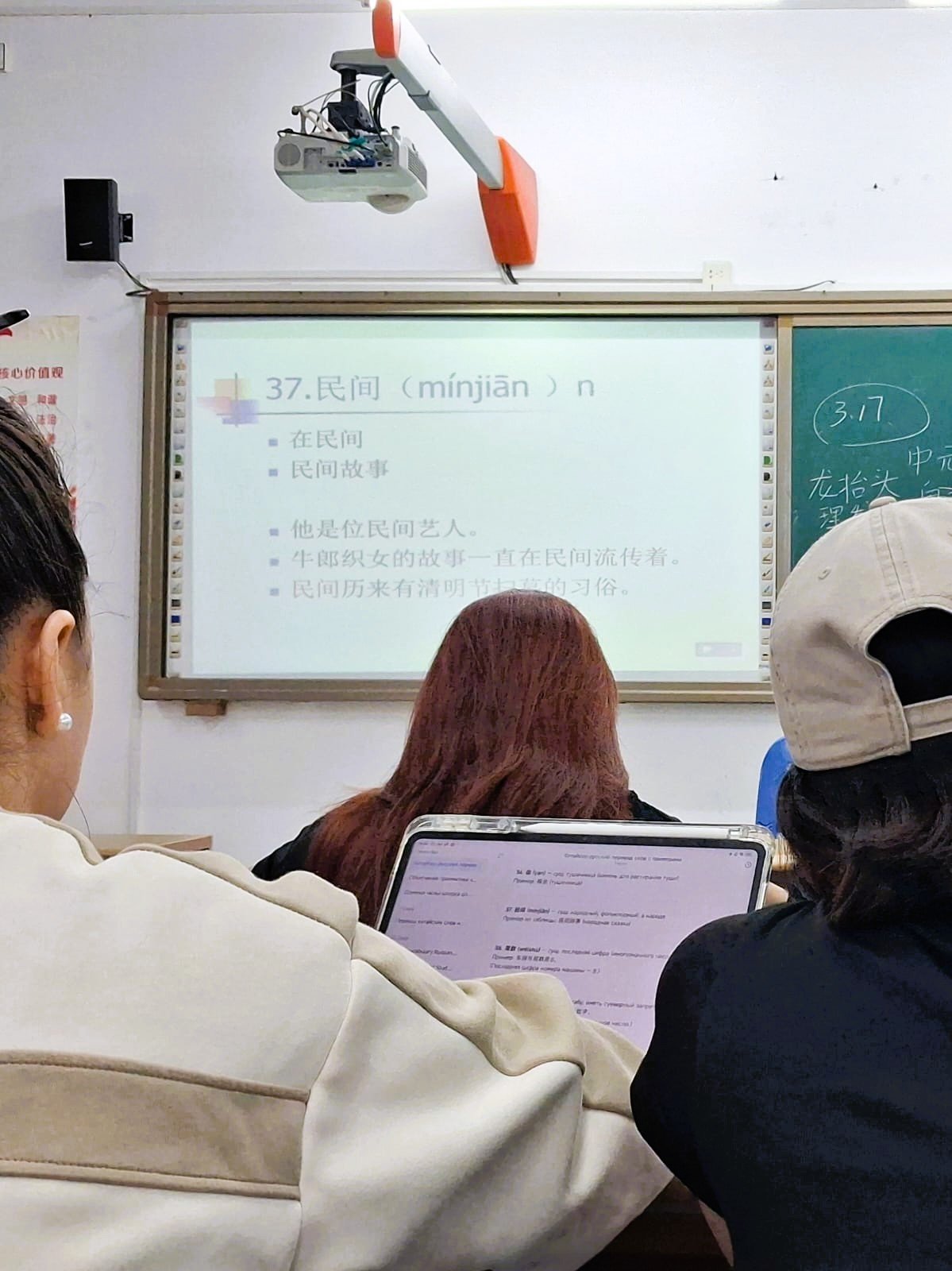
The class itself felt eerily similar to my own pre-major Mandarin class. She had a PPT explaining vocabulary and example sentences, explaining each word before going around the room asking students to come up with their own examples.
The differences and similarities were both striking. The biggest difference was the energy — students taking a Mandarin Language major are so much more active in class. So many hands up, ready to give example sentences. Some students clearly had more advanced vocabulary than me and were constructing long, complex sentences using words I’d never even heard.
I actually got called on to make an example sentence too. The whole lecture I was itching to take notes, but didn’t — the teacher already knew I was just there to listen, so there was no need to pretend.
I asked my friend afterward about homework and workload — apparently it’s heavier than what we get in pre-major classes.
Since this is a Mandarin Language major designed specifically for foreign students, the teacher spoke at a natural-but-manageable pace, with very standard, clear Mandarin (很标准). Her explanations were genuinely easy to follow.
Tourism Law (Tourism Major) — 45% Understanding
Another one I sat in on thanks to my friend’s offer. This time the teacher dressed pretty casually, working through a PPT explaining various rules and regulations — a very classic lecture style for a theory-heavy subject.
I never attended university in my home country, so I can’t compare directly, but I remember that in high school, teachers would actively ask questions and pull students into the discussion. Here, the teacher only asked rhetorical questions and answered them herself.
That’s when it hit me: Chinese lectures (at least the ones I’ve seen) tend to be less about back-and-forth interaction and more about structured, one-directional transmission of information. The teacher probably doesn’t know most of her students by name — she likely just remembers a handful and gets fuzzy on the rest.
Understanding-wise, this one landed close to the Macroeconomics lecture, just slightly easier since the theory was simpler and she used fewer technical terms.
Probability and Statistics, Artificial Intelligence Major — 30% Understanding
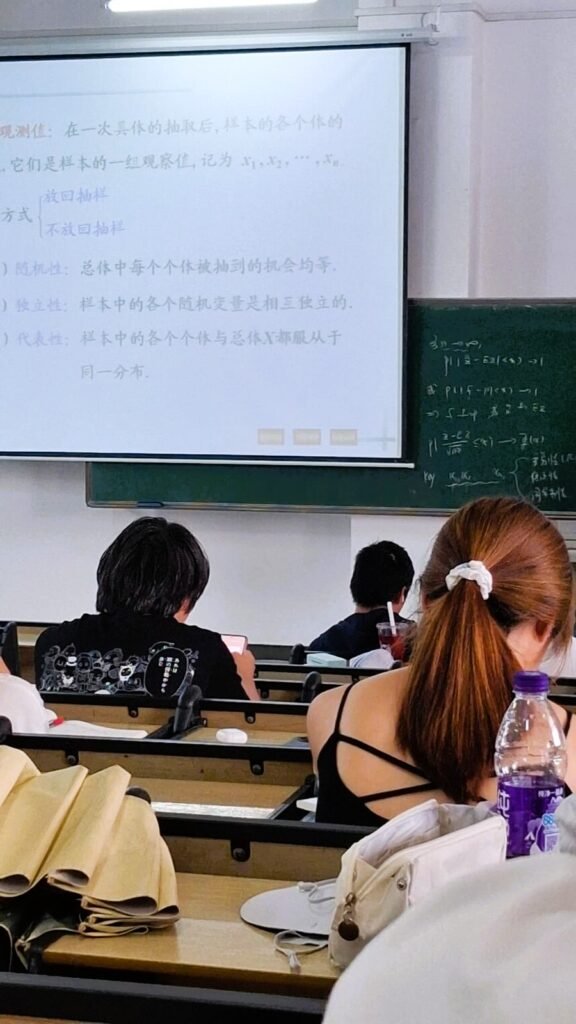
This was the lecture I was genuinely scared to attend. Because of certain circumstances, I couldn’t go with the person who’d given me the class info, so I walked in completely alone — and couldn’t even spot them in the sea of students once I sat down.
I felt like a total impostor this time. In my heart, I was desperately hoping nobody would say a word to me.
But out of every class on this list, this one was actually the most useful — because it’s one of the classes I’ll genuinely have to take next year. I’m glad I got the preview, even if it terrified me.
There were so many math-specific terms I simply didn’t know — I didn’t even know the Mandarin word for “function” or “variable.” This was rough. Honestly, even if this class were taught in English, I think I’d still find it challenging (to be fair, I also walked in near the end of the semester without the foundational lessons). But combine unfamiliar math concepts with a language barrier, and it gets genuinely hard.
I’m so screwed next year.
E-Commerce, Business and Economics Major (商务经济) — 85% Understanding
Out of all the non-language majors, this one was by far the easiest to follow. Though when I asked my friend about it afterward, she said this particular subject is actually one of the easier ones in her major — she’d struggled a lot more at the start of the semester with other classes. So this one lecture isn’t necessarily representative of the whole major.
The teacher used a PPT (again, the classic format for theory classes), but he was unusually active about getting students to participate — walking around the room multiple times asking real questions that wanted real answers.
I happened to catch the very last class of the semester, so he was going around checking in on everyone’s exam (期末考试) prep, asking if they had their materials sorted.
Funniest moment of the whole experiment: when he got to me after asking my friend the same question, I just said “跟她一样” (same as her). He nodded and moved right along to the next student without a second thought.
The teacher never clocked that there was an impostor in the room, hahaha.
This is the only other major (besides the Mandarin Language major) designed specifically for foreign students, so he genuinely understood the struggle. I followed his explanations pretty well. He spoke at a natural, not-too-fast pace — not as polished as the Mandarin Language teacher, but clear — and he’d occasionally point out specific words he assumed students might not know and explain them on the spot.
Advanced Math (高等数学), Software Engineering (软件工程) — 40% Understanding
Another subject I’ll be taking next year. The teacher taught it like any math teacher anywhere — board completely covered in equations I was desperately trying to decode.
I really tried to follow along, but I couldn’t. My friend said it’s probably because I missed the foundational lessons from the start of the semester, when it was still manageable. I really hope that’s the actual problem :’D.
Same issue as Probability and Statistics — a ton of math vocabulary I just didn’t have. I could somewhat follow his explanations while he worked through solving an equation, but I still couldn’t solve them myself.
What I Actually Learned From All This
I think the real takeaway here is that there’s a real gap between understanding Mandarin and learning through Mandarin. High-level academic study demands fluency in technical, subject-specific terminology — and you simply can’t get there relying on the general vocabulary taught in standard Mandarin coursebooks.
I’m genuinely glad I did this whole experiment. Now I actually know what to focus on during the break before my major starts. My hope is that all this exposure will soften the “shock” of attending real classes alongside local students next year.
Here’s what I really think, at the end of it all: I might be a little crazy, but I believe I can actually do this — if I really study. And by “really study,” I mean going back after every lecture, reviewing everything, and drilling the terminology until it sticks. It’s doable. I just need to work twice as hard as Chinese students do.
I just hope that all the difficulty I’m facing now becomes proof of capability later.




Leave a Reply